About me:
The monarch is the state insect of Alabama, Idaho, Illinois, Minnesota, Texas, and the state butterfly of Vermont and West Virginia. It was nominated in 1990 as the national insect of the United States of America, along with the honeybee (Apis mellifera), but the legislation did not pass.
Many people like to attract monarchs by growing a butterfly garden. Others enjoy raising them for pleasure or for educational purposes. For migrating flocks, sanctuaries have been created at favorite wintering locations; Even tourism revenue is thus generated.
Many schools also enjoy growing, and attending to monarch butterflies, starting with the caterpillar form. When the butterflies reach adulthood they are then released into the wild.
MIGRATION:
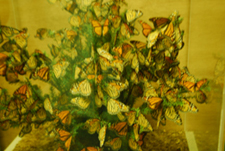
Monarchs are especially noted for their lengthy annual migration. In North America they make massive southward migrations starting in August until the first frost. A northward migration takes place in the spring. (In Australia, they make limited migrations in cooler areas, but the blue tiger butterfly is better known in Australia for its lengthy migration.) Female monarchs deposit eggs for the next generation during these migrations. By the end of October, the population of the Rocky Mountains migrates to the sanctuaries in the area of Angangueo, Ocampo, Zitácuaro and El Rosario in the Mexican state of Michoacán. The western population overwinters in various sites in central coastal California, United States, notably in Pacific Grove and Santa Cruz.
The length of these journeys exceeds the normal lifespan of most monarchs, which is less than two months for butterflies born in early summer. The last generation of the summer enters into a non-reproductive phase known as diapause and may live seven months or more. During diapause, butterflies fly to one of many overwintering sites. The generation that overwinters generally does not reproduce until it leaves the overwintering site sometime in February and March. It is thought that the overwinter population may reach as far north as Texas and Oklahoma during the spring migration. It is the second, third and fourth generations that return to their northern locations in the United States and Canada in the spring. How the species manages to return to the same overwintering spots over a gap of several generations is still a subject of research; the flight patterns appear to be inherited, based on a combination of circadian rhythm and the position of the sun in the sky.
Monarch butterflies are one of the few insects capable of making transatlantic crossings. They are becoming more common in Bermuda due to increased usage of milkweed as an ornamental plant in flower gardens. Monarch butterflies born in Bermuda remain year round due to the island's mild climate.
A few monarchs turn up in the far southwest of Great Britain in years when the wind conditions are right, and have been sighted as far east as Long Bennington. Monarchs can also be found in New Zealand. On the islands of Hawaii no migrations have been noted. |